
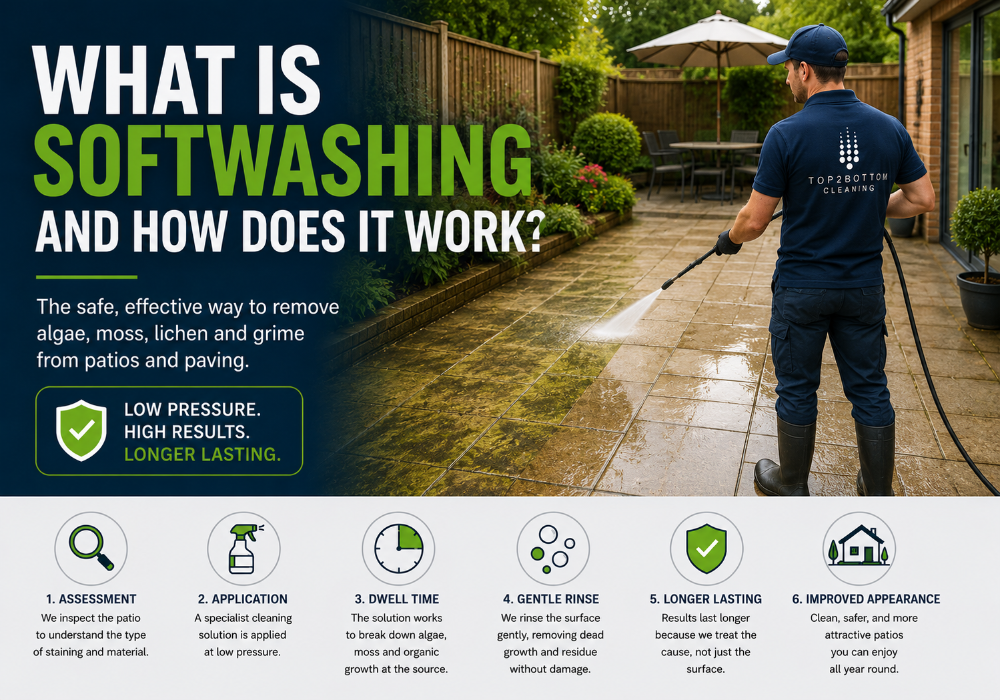
What Is Softwashing And How Does It Work? This is a common question for homeowners and businesses that want to clean exterior surfaces without using harsh pressure. Softwashing is a controlled exterior cleaning method that uses low-pressure water and specialist cleaning solutions to remove organic growth, staining and surface dirt.
Unlike standard pressure washing, softwashing does not rely on force alone. Instead, it treats the cause of the staining. This makes it especially useful on surfaces affected by algae, moss, lichen, mould and black or green staining.
Softwashing can be used on many outside surfaces, including render, patios, driveways, walls, paths, cladding and some roof surfaces. However, the correct method depends on the surface, the level of growth and the condition of the material being cleaned.
For property owners, softwashing offers a practical way to improve appearance, protect surfaces and reduce the speed of organic regrowth. It is not just about making an area look cleaner on the day. Instead, it supports longer-lasting exterior maintenance.
How Is Softwashing Different From Pressure Washing?
Pressure washing uses high-pressure water to blast dirt away from a surface. It can be very effective on strong materials such as concrete, block paving and some stone surfaces. However, high pressure is not always suitable.
Softwashing uses much lower pressure. The cleaning solution does most of the work, while the rinse removes loosened dirt, dead organic matter and residue. Because of this, softwashing can be a better option for delicate or porous surfaces.
Pressure washing relies on force
With pressure washing, the cleaning effect comes mainly from water pressure. This can remove built-up dirt quickly, but it can also disturb joints, damage soft stone, mark render or force water into areas where it should not go.
For example, aggressive pressure washing may damage older patios, painted surfaces or exterior render. It may also strip sand from block paving joints if used incorrectly.
Softwashing treats the growth
Softwashing works differently because it targets organic growth at the source. Algae, moss, lichen and mould are treated with a suitable cleaning solution. After treatment, the staining breaks down, and the surface can be rinsed or left to weather naturally, depending on the method used.
This is one reason softwashing often gives longer-lasting results than water pressure alone. It deals with the living growth rather than only removing the visible top layer.
Why Do Exterior Surfaces Turn Green, Black, or Slippery?
Outdoor surfaces face constant exposure to rain, shade, pollution, damp air and airborne spores. Over time, these conditions allow organic growth to spread across patios, driveways, render and walls.
Green staining usually comes from algae. Black marks may come from mould, pollution, lichen or deeply embedded biological staining. Meanwhile, slippery patches often form when moss and algae hold moisture on the surface.
Shaded areas usually suffer most. For instance, north-facing walls, paths under trees and patios with poor drainage often develop staining faster than open, sunny areas.
Algae growth
Algae thrives where moisture sits for long periods. It often appears as green staining on render, paving, brickwork, fencing and decking. Although it may look like surface dirt, it can return quickly if it is not treated properly.
Moss growth
Moss grows well on damp, shaded and uneven surfaces. It can hold water against patios, driveways and roof materials. As a result, surfaces may become slippery and harder to keep clean.
Lichen and black spots
Lichen can be harder to remove than ordinary dirt. It often appears as black, white or pale patches on paving and stone. Because lichen attaches firmly to the surface, it usually needs a more targeted cleaning approach.
How Does The Softwashing Process Work?
The softwashing process should always begin with a proper surface inspection. A professional cleaner will look at the material, staining, drainage, access, nearby plants and any areas that need protection.
Although the exact method can vary, most softwashing jobs follow a clear process. This helps protect the surface and achieve a more even result.
Step 1: Surface assessment
The first step is to identify the type of surface. Render, stone, concrete, block paving, brick and timber all behave differently. Therefore, the cleaning method must suit the material.
A cleaner should also check for cracks, loose pointing, damaged render, flaking paint or unstable areas. These issues matter because cleaning can reveal existing damage or make weak areas more visible.
Step 2: Preparation and protection
Before treatment begins, the area should be prepared. This may include moving furniture, clearing loose debris, protecting plants and checking where rinse water will drain.
Preparation is especially important around lawns, borders, ponds, painted surfaces and sensitive materials. Responsible product use matters, and the Health and Safety Executive provides guidance on using, storing and disposing of biocides safely: HSE guidance on using biocides.
Step 3: Application of the cleaning solution
The softwashing solution is applied at low pressure. It is usually sprayed evenly over the affected surface. The aim is to give the solution enough contact time to break down organic staining.
Contact time is important. If the solution is rinsed too soon, it may not work properly. However, it should not be allowed to dry out on unsuitable surfaces. This is why experience matters.
Step 4: Dwell time
Dwell time is the period when the solution remains on the surface and does its work. During this stage, staining may change colour as algae, moss, or lichen start to break down.
The correct dwell time depends on the surface, temperature, weather and level of growth. On heavily stained areas, a second application may sometimes be needed.
Step 5: Gentle rinsing or controlled finishing
Some softwashing treatments are rinsed after the solution has worked. Other treatments may be left to continue working and then weather away naturally over several days or weeks.
The right approach depends on the surface and the cleaning goal. For example, render cleaning often needs careful rinsing to avoid streaking. However, some moss and algae treatments continue to improve gradually after application.
What Surfaces Can Be Softwashed?
Softwashing is suitable for many exterior cleaning tasks, but it is not a one-size-fits-all method. The best results come from choosing the right solution, strength, application method and rinsing process for each surface.
Render
Render is one of the most common surfaces cleaned by softwashing. Many rendered homes develop green, red or black staining, especially on shaded elevations.
High-pressure washing can damage render or force water behind the surface. Therefore, softwashing is often a safer option. It treats organic staining without relying on aggressive pressure.
Patios
Patios can collect algae, moss, lichen and general grime. Softwashing can help restore colour and reduce slippery organic growth, especially when used alongside careful pressure washing where suitable.
Older patios may benefit from a gentler approach because slabs, pointing and natural stone can become fragile over time.
You can also read more about our patio cleaning service.
Driveways
Driveways often suffer from moss, algae, tyre marks, weeds and surface dirt. Softwashing can support driveway cleaning by treating organic growth after loose material has been removed.
On block paving, softwashing may be combined with pressure washing, re-sanding and sealing where appropriate. This helps improve appearance and reduce future maintenance.
For more information, visit our driveway cleaning service.
Walls and brickwork
Brick walls, boundary walls and retaining walls often become stained because they stay damp. Softwashing can remove green growth and improve the overall look of the property.
However, older brickwork and weak mortar need care. A professional should avoid excessive pressure and choose a method that respects the condition of the wall.
Cladding and exterior panels
Commercial buildings often use cladding, panels and coated surfaces. These areas can develop algae and pollution staining. Softwashing can clean them without the risk of harsh blasting.
However, the cleaner must understand the surface coating and manufacturer guidance before applying any chemical treatment.
Why Softwashing Can Give Longer-Lasting Results
Softwashing often lasts longer than simple pressure washing because it treats the biological growth causing the staining. When pressure washing only removes the visible layer, spores and roots may remain in pores, joints and textured areas.
Because softwashing targets the growth, the surface usually stays cleaner for longer. However, no exterior cleaning method can stop nature permanently. Rain, shade, trees and damp conditions will always influence regrowth.
It reaches into textured surfaces
Many exterior materials have small pores, joints and uneven areas. Dirt and growth settle into these spaces. Pressure washing may remove the surface layer, but softwashing can treat growth within those harder-to-reach areas.
It reduces fast regrowth
When algae or moss remains active, it can return quickly. Softwashing helps slow this process by treating the living growth. As a result, the surface often stays cleaner for a longer period.
It supports planned maintenance
Softwashing works well as part of regular exterior maintenance. Rather than waiting until surfaces become heavily stained, property owners can schedule periodic treatment to keep areas cleaner and safer.
Is Softwashing Safe?
Softwashing can be safe when carried out correctly. However, it must be done with the right products, correct dilution, suitable protective measures and proper rinsing or control.
The word “soft” refers to the water pressure, not the strength of the cleaning solution. Therefore, product handling and surface knowledge are important.
Safe use depends on training and care
A professional cleaner should understand product labels, application rates, personal protective equipment and environmental precautions. They should also know when not to apply a treatment.
For example, windy weather can cause overspray. Hot weather can make solutions dry too quickly. Heavy rain can reduce effectiveness and increase run-off.
Plants and the surrounding areas need protection
Nearby plants, grass, ponds and delicate surfaces may need protection before cleaning begins. This can include pre-wetting, covering sensitive areas and controlled rinsing.
A careful cleaner will assess the whole area, not just the stained surface. This protects the property and helps avoid unnecessary damage.
Biocidal products must be used responsibly
Some softwashing treatments use biocidal products. In the UK, biocidal products are regulated, and users are responsible for correct use. The HSE explains that biocides must be used, stored and disposed of safely to prevent harm to people, pets, wildlife and the environment.
The wider cleaning sector also places strong emphasis on correct cleaning standards and responsible practice. The British Cleaning Council is a recognised UK industry body for cleaning, hygiene and waste services.
What Are The Main Benefits Of Softwashing?
Softwashing offers several benefits for homeowners, landlords, commercial sites and property managers. It can improve appearance, support safety and help protect exterior surfaces from ongoing organic growth.
Improves kerb appeal
Green render, stained paving and moss-covered driveways can make a property look older and poorly maintained. Softwashing helps restore a cleaner appearance without unnecessary surface aggression.
This can be especially useful before selling a home, welcoming customers or preparing a commercial site for inspection.
Reduces slippery growth
Algae and moss can make paths, patios and driveways slippery. Softwashing treats these growths and can help reduce slip risks when combined with suitable cleaning and maintenance.
However, heavily contaminated surfaces may still need mechanical cleaning before treatment. A professional assessment will confirm the right approach.
Protects delicate surfaces
Some surfaces should not be blasted with high pressure. Softwashing gives cleaners another option for delicate areas, including render, painted walls, older stone and some roof materials.
Helps delay regrowth
Because the treatment targets organic growth, results can last longer than a simple rinse or pressure wash. This makes softwashing useful for areas that suffer repeated green staining.
Works well for domestic and commercial properties
Softwashing is not limited to homes. It can also help schools, offices, care homes, retail units, industrial buildings and hospitality sites keep exterior areas presentable.
When Should You Choose Softwashing?
Softwashing is often the right choice when staining comes from organic growth rather than loose dirt alone. It is also useful when the surface may not tolerate high pressure.
You should consider softwashing if your exterior surfaces show green staining, black marks, moss, lichen, mould or repeated damp-related discolouration.
Choose softwashing for stained render
If your render has green or dark staining, softwashing is usually more suitable than pressure washing. It can clean the surface while reducing the risk of etching, scarring or water ingress.
Choose softwashing for recurring algae
If algae returns soon after pressure washing, the underlying growth may not have been treated. Softwashing can help tackle this problem more effectively.
Choose softwashing for older or delicate surfaces
Older patios, weathered stone, weak pointing and delicate walls need care. Softwashing may offer a gentler alternative, although the surface must still be inspected first.
When Might Pressure Washing Still Be Needed?
Softwashing is powerful, but it does not replace every cleaning method. In many cases, the best result comes from combining methods carefully.
For example, a driveway with heavy mud, weeds and compacted dirt may need pressure washing first. After that, a softwash or biocidal treatment can help treat remaining organic growth.
Heavy surface dirt
Softwashing does not always remove thick mud, sand, loose debris or compacted soil on its own. Mechanical cleaning may be needed before treatment.
Weeds and joint debris
Block paving joints often collect weeds and dirt. These areas may need pressure washing, manual removal and re-sanding before any further treatment.
Oil and rust staining
Softwashing mainly targets organic growth. Oil stains, rust marks and cement residue often need different specialist products and methods.
How Long Does Softwashing Take To Work?
Some softwashing results appear quickly. Green algae may fade during treatment, especially when the staining is light. However, heavier growth can take longer to break down fully.
In some cases, the surface continues to improve over days or weeks. This is common when a treatment is designed to keep working after application.
Immediate improvement
Many surfaces look cleaner on the same day, particularly after rinsing. Render, walls and patios can show visible changes soon after treatment.
Gradual weathering
Some dead organic matter may loosen over time and wash away naturally with rain and weather. This can create a gradual improvement rather than an instant finish.
Repeat treatment for stubborn growth
Black spots, lichen and heavy moss may need more than one treatment. A professional cleaner should explain this before starting, so expectations are clear.
How Often Should Softwashing Be Carried Out?
The frequency depends on the property, surface type and local conditions. Shaded, damp and tree-covered areas usually need cleaning more often than sunny, open areas.
As a general guide, many exterior surfaces benefit from cleaning or treatment every one to three years. However, some high-risk areas may need more regular maintenance.
Render maintenance
Rendered walls may need softwashing every few years, especially if they face north or sit close to trees. Regular maintenance can prevent staining from becoming severe.
Patio and pathway maintenance
Patios, paths and garden areas may need annual checks. If algae starts to return, early treatment can help prevent slippery build-up.
Driveway maintenance
Driveways often need periodic cleaning because they collect dirt, moss and tyre residue. Softwashing can be part of a wider driveway care plan.
Can Homeowners Do Softwashing Themselves?
Some homeowners try DIY softwashing products. However, professional cleaning is usually safer and more effective, especially on render, roofs, commercial sites or heavily stained areas.
The main risks include using the wrong product, applying too much, damaging plants, staining nearby materials or failing to protect drainage areas.
DIY mistakes can cause damage
Using a strong product on the wrong surface can lead to bleaching, streaking or surface damage. Poor rinsing can also leave residue behind.
Professional cleaners understand surface limits
A trained cleaner knows how to assess surfaces, select suitable products and control the application. This reduces risk and improves the final result.
Access and safety matter
Cleaning high walls, roofs, upper-storey render, or commercial elevations can involve working at height. This should only be done with suitable equipment and safe working methods.
Common Softwashing Myths
Several myths surround softwashing. These can lead property owners to choose the wrong method or expect unrealistic results.
Myth 1: Softwashing is just weak pressure washing
This is not correct. Softwashing is a different cleaning process. It uses low pressure and cleaning chemistry to treat organic growth.
Myth 2: Softwashing gives instant, perfect results every time
Some results are immediate, but others develop gradually. Stubborn lichen, black spots and deep staining may take longer to fade.
Myth 3: All exterior surfaces need the same treatment
Every surface is different. Render, stone, brick, concrete and timber all need different levels of care.
Myth 4: Pressure washing is always faster and better
Pressure washing can be useful, but it is not always better. On delicate or stained surfaces, softwashing may provide a safer and longer-lasting result.
What Should You Check Before Booking Softwashing?
Before booking a softwashing service, ask how the cleaner will assess your property. A responsible company should explain the process, risks, likely results and aftercare.
You should also ask whether nearby plants, lawns, ponds and sensitive surfaces will be protected. This is especially important when cleaning close to garden areas.
Ask about experience
Choose a company with experience in the surface you need cleaned. Render cleaning, patio cleaning and driveway cleaning all require different techniques.
Ask about the expected result
A good cleaner will be honest. Some stains may lift immediately, while others may improve gradually. Severe staining may need more than one visit.
Ask about aftercare
Aftercare can make results last longer. This may include improving drainage, trimming overhanging plants, brushing surfaces regularly and booking future maintenance before staining becomes severe.
Is Softwashing The Right Option For Your Property?
Softwashing is a strong option if your exterior surfaces suffer from algae, moss, lichen, mould or weather-related staining. It works especially well where high-pressure cleaning may be too aggressive.
However, the best method always depends on the surface and the type of staining. In some cases, softwashing alone is enough. In others, it works best as part of a combined cleaning process.
If you want to improve kerb appeal, reduce slippery growth and protect delicate surfaces, softwashing is worth considering. A professional assessment will help confirm whether it is suitable for your patio, driveway, render, walls or commercial exterior.
For tailored advice, speak to a professional exterior cleaning company and ask for a clear explanation of the method, products, safety steps and expected results before work begins.


